Red Light Therapy for Muscle Recovery
Most people who look into red light therapy for muscle recovery have more questions than answers. But the research behind red light therapy benefits is real, peer-reviewed, and highly reliable. Let’s walk through how it works, what the studies actually show, and what to expect from a red light therapy session at dtXfy.
What Red Light Therapy for Muscle Recovery Actually Involves
We’re not talking about heat therapy. That distinction matters more than most people realize, because it’s what separates the mechanism of PBM from the benefits of infrared sauna – two services that are often mixed up, but work in completely different ways.
Red light therapy delivers specific wavelengths of light in the red and near-infrared spectrum directly to the body. While red light primarily interacts with surface tissue (skin, subcutaneous layers, and the upper portions of muscle), near-infrared light reaches skeletal muscle and underlying structures several centimeters down. This deeper reach is what makes it particularly relevant for muscle recovery therapy.
The process is photochemical, not thermal, which means neither wavelength produces meaningful heat. Light is absorbed by specific molecules within the cell, and that absorption triggers biological changes. This is the part that surprises most people – how can something as passive as standing in front of a light panel be doing anything at all at the cellular level?
Red Light vs. Near-Infrared: A Quick Reference
| Parameter | Red Light | Near-Infrared Light | Session at dtXfy |
|---|---|---|---|
| Wavelength | 630-660 nm | 810-880 nm | Both wavelengths delivered simultaneously – Class II medical-grade |
| Tissue depth | Skin and subcutaneous surface tissue | Skeletal muscle and deeper underlying structures | Full body – surface and deep tissue covered in one session |
| Primary benefit | Skin health, collagen stimulation, surface tissue repair | Muscle recovery, mitochondrial energy support, inflammation | Combined effect across skin, muscle, and cellular repair |
| Heat produced | None – photochemical process only | None – photochemical process only | Warm but no sweating or discomfort |
| Session length | 10-20 min typical on consumer devices | 10-20 min typical on consumer devices | Muscle recovery, mitochondrial energy support, and inflammation |
The fact that dtXfy uses Class II medical-grade equipment is worth noting because device quality directly affects outcome. Consumer-grade panels deliver a fraction of the irradiance of clinical systems, which means the same 10-minute session produces a meaningfully different energy dose depending on the equipment used.
How Photobiomodulation Therapy Works Inside the Cell
The science of photobiomodulation centers on the mitochondria, the part of our cells that convert oxygen and nutrients into ATP, the molecule used to power virtually every biological process: repair, protein synthesis, regeneration – all of it runs on ATP.
What researchers found is that mitochondria are photoacceptors: they absorb red and near-infrared light and respond by improving the efficiency of energy production.
In practical terms, this absorption influences mitochondrial activity at levels that support repair rather than cause damage. The effect is most pronounced in cells that are already under stress, which is exactly the state skeletal muscle is in after a training session.
This is worth being precise about, because overstatements in this space are common. Red light therapy does not add energy to the body directly. The more accurate framing is that photobiomodulation therapy appears to support more efficient cellular metabolism in cells that are compromised or fatigued.
What the Research on Red Light Therapy Benefits Shows
Photobiomodulation has been studied seriously in sports medicine, rehabilitation medicine, and cellular biology for well over a decade. The evidence is strong enough to support its use as a complementary recovery tool, but it’s worth being clear about what the research actually claims, rather than what wellness marketing often implies.
What peer-reviewed research shows
A 2016 systematic review by Leal-Junior et al., published in Lasers in Medical Science, concluded that PBM can improve muscle performance, reduce fatigue, and accelerate recovery following exercise. Notably, this held for both pre-exercise and post-exercise applications, which suggests that the timing of treatment is flexible rather than fixed.
A randomized controlled trial by de Marchi et al. (2012) found reductions in creatine kinase in participants who received photobiomodulation compared to controls. Lower levels of this muscle damage biomarker indicate less tissue damage and correlate with faster recovery timelines.
Research by Ferraresi et al. (2015), published in the Journal of Athletic Training, demonstrated improvements in muscle strength and endurance alongside delayed onset of fatigue when PBM was applied before exercise.
There’s one thing the research does not claim: that photobiomodulation replaces the fundamentals. Sleep, nutrition, and appropriate training load management are not optional. Red light therapy for muscle recovery works as a complement to those basics, but it’s no substitute for them. Any framing otherwise misrepresents what the science actually supports.
What Clients at dtXfy Actually Notice
Reading about cellular mechanisms is useful, but it rarely tells you what actually changes day to day, and that’s the question most people ask when considering adding a new recovery practice.
“What I notice most with clients who come in consistently is that the soreness conversation shifts. They stop treating that heavy, two-day feeling after a hard workout as a given. It doesn’t disappear entirely, but it stops being the thing that sidetracks their whole week.” – Denise, founder of dtXfy.
This client’s experience lines up directly with what the research describes at the cellular level. Photobiomodulation does not eliminate the inflammatory response that follows exercise, nor should it, as some inflammation is necessary for adaptation. What appears to change is the duration and intensity of that phase – it’s the prolonged, disruptive soreness that most people want addressed, not the signal itself. Which brings up something worth knowing before a first session: the experience itself doesn’t feel like much. That’s a reflection of where the work actually happens.
Clients who come expecting a dramatic physical sensation often find the experience quieter than anticipated. The panels are warm but produce no sweating or discomfort, and most people use the 10 minutes to decompress. The results show up later, in how the body responds over the following 24 to 48 hours, not in how the session feels at the moment.
What to Expect From a Red Light Therapy Session in Pennsylvania (Wayne or Philadelphia Locations)
Knowing the science is one thing. Knowing what actually happens when you walk through the door is what finally determines whether someone books.
Before the Session
No special preparation is required. Removing lotions, oils, or sunscreen from the skin beforehand is recommended, as some products can reduce light penetration. Other than that, just wear minimal clothing, or none at all, in your private session space, since the goal is to expose as much skin surface as possible. You don’t need to fast, time your meals differently, or adjust your workout schedule around the appointment.
During the Session
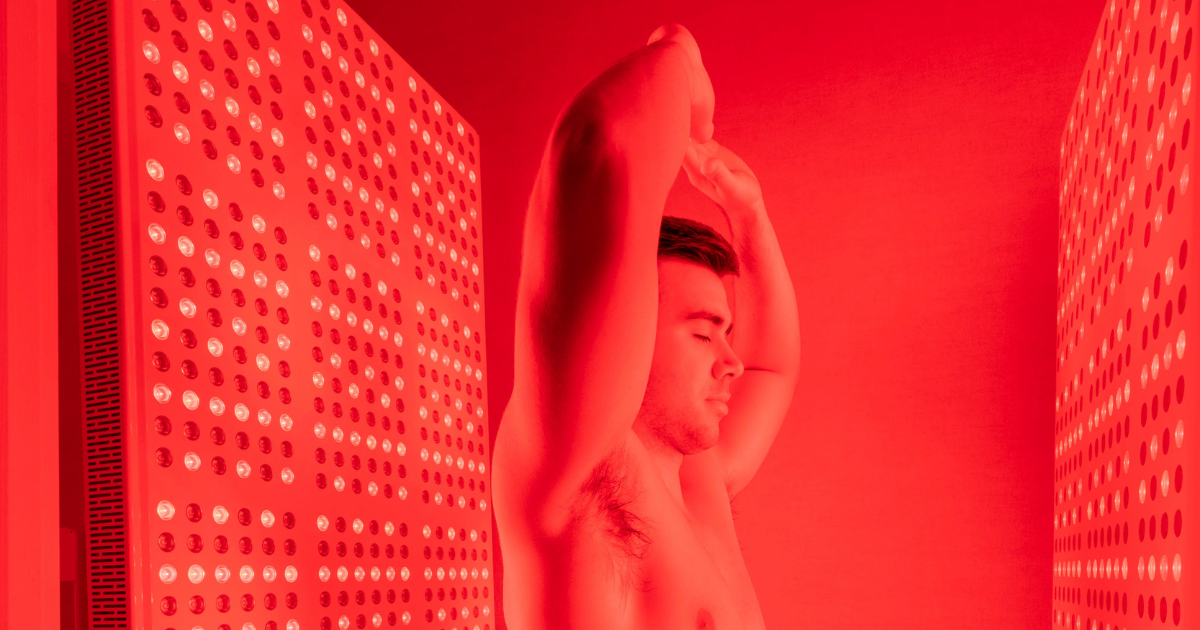
At dtXfy’s Philadelphia and Wayne studios, you stand between two full-body Class II medical-grade panels for 10 minutes. The panels deliver red and near-infrared light simultaneously across the entire body. There is a warmth to the light, but nothing that produces sweating or discomfort. Most clients stand quietly. Some bring earbuds. The 10 minutes pass faster than expected. There is no one right way to use the time.
After the Session
Hydration is sensible after any wellness treatment, though red light therapy does not cause the fluid loss that an infrared sauna does. The effects of muscle recovery therapy at the cellular level happen over hours, not minutes, so walking out feeling dramatically transformed after a single session is the wrong expectation. The consistent finding in research and in our experience with clients is that the meaningful changes are cumulative, showing up after two to four weeks of regular sessions, not after one.
Who Should Check with Their Doctor First
Red light therapy has a strong safety profile at the wavelengths and durations used in clinical and studio settings. That said, a conversation with your physician before starting is the right call if you are pregnant, have a photosensitivity condition, take medications that increase light sensitivity, or have active skin conditions in treatment areas. If there is any question, that conversation belongs before booking, not after.